
Wire Rope Sling Capacity and Safety Standards: Complete IS 2762 Guide for India
What Is a Wire Rope Sling and How Is Working Load Limit Calculated?
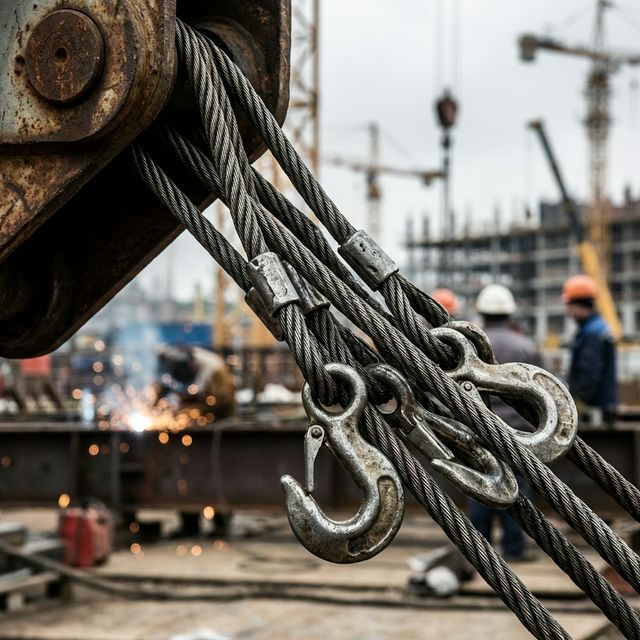
A wire rope sling is a lifting accessory manufactured from wire rope, fitted with end terminations — typically swaged ferrule eyes, hand-spliced eyes, or spelter sockets — used to connect a suspended load to a crane hook, hoist, or lifting beam. The single most critical specification of any wire rope sling is its Working Load Limit (WLL): the maximum mass that the sling is permitted to support in a straight vertical (in-line) pull under normal operating conditions. Nesh Industries, based in Mehsana, Gujarat, manufactures wire rope slings to IS 2762 and can confirm that understanding WLL calculation is the foundation of every safe lift.
The WLL is derived from the rope's Minimum Breaking Force (MBF) — the verified tensile breaking load of the assembled rope, confirmed by destructive test — divided by the safety factor specified by the governing standard. IS 2762 (Specification for Wire Rope Slings) mandates a safety factor of 5:1 for wire rope slings used in general lifting service. This means the sling's MBF must be at least five times the intended working load.
Formula: WLL = MBF ÷ Safety Factor
Worked example: A 16mm diameter 6×19 IWRC wire rope has a Minimum Breaking Force of approximately 176 kN per IS 2266. Applying the IS 2762 5:1 safety factor: WLL = 176 kN ÷ 5 = 35.2 kN, or approximately 3.59 tonnes. This is the maximum load that a single-leg vertical sling made from this rope can safely carry. Every sling supplied by Nesh Industries is marked with its WLL on a permanently attached metal tag, as required by IS 2762. Never use a sling whose tag is missing, illegible, or whose recorded WLL is less than the intended load.
How Does Sling Angle Affect Working Load Limit?
Sling angle is the most important technical concept in rigging safety — and the cause of more rigging accidents than any other single factor in Indian construction and manufacturing environments. When a multi-leg sling is used to lift a load, the legs are rarely vertical: they run from the crane hook at an angle down to the attachment points on the load. This angle dramatically increases the tension in each sling leg beyond the weight of the load alone, reducing the effective WLL that each leg can safely carry.
The relationship between sling angle and leg tension is governed by trigonometry. As the angle from vertical (measured between the sling leg and the vertical centreline) increases — meaning the sling becomes more horizontal — the tension in each leg increases. Equivalently, as the included angle between sling legs increases, the rated WLL per leg decreases. IS 2762 and the associated code of practice IS 4573 express this as an angle factor applied to the rated WLL.
The four critical sling angle factors are:
- 90° to vertical (sling legs vertical): Angle factor = 1.000 — each leg carries 100% of its rated WLL. This is the ideal configuration, used only when the attachment points allow perfectly vertical sling legs.
- 60° to vertical (30° included angle between legs): Angle factor = 0.866 (√3/2) — each leg carries only 86.6% of its rated WLL. A very common and acceptable rigging angle for most lifts.
- 45° to vertical (90° included angle): Angle factor = 0.707 (1/√2) — each leg carries only 70.7% of its rated WLL. This is the boundary angle for normal lifting practice; WLL loss is significant.
- 30° to vertical (120° included angle): Angle factor = 0.500 — each leg carries only 50% of its rated WLL. IS 2762 prohibits sling use below this angle because leg tensions exceed safe limits and lateral load on the crane hook becomes excessive.
Worked example — 5-tonne load on a 2-leg sling at 45°: The load is 5 tonnes. With a 2-leg sling, each leg nominally shares 5 ÷ 2 = 2.5 tonnes. However, at a 45° angle from vertical, the angle factor is 0.707. The actual tension in each leg = 2.5 t ÷ 0.707 = 3.54 tonnes per leg. Applying the IS 2762 5:1 safety factor, the required MBF per sling leg = 3.54 × 5 = 17.7 tonnes = 173.6 kN. Each sling leg must therefore have a rated WLL of at minimum 3.54 tonnes at vertical — meaning the sling rope itself must have an MBF of at least 173.6 kN. A 14mm 6×19 IWRC wire rope (MBF approximately 135 kN) would be inadequate; a 16mm rope (MBF approximately 176 kN) meets the requirement. Never estimate sling angle by eye — always measure with an inclinometer or calculate from the geometry of the load and lift point.
What Are the Different Wire Rope Sling Configurations and Their WLL Ratings?
IS 2762 defines the standard wire rope sling configurations and specifies how WLL is rated for each. Understanding the WLL multiplier for each configuration is essential for correct sling selection in Indian rigging practice.
- Single-leg sling (1-leg vertical hitch): This is the baseline configuration. WLL = rated single-leg WLL. Used for loads with a single, central lift point. Per IS 2762, the load must hang freely vertical to use the full rated WLL.
- 2-leg bridle sling at 60° (included angle 60°, legs at 30° from vertical): WLL multiplier = 1.73× single-leg WLL. A 2-leg bridle sling at 60° included angle provides the highest WLL of the standard bridle configurations for two attachment points. The angle factor at 30° from vertical is 0.866; for two legs, the combined capacity = 2 × 0.866 = 1.732× a single-leg rated WLL.
- 2-leg bridle sling at 90° (included angle 90°, legs at 45° from vertical): WLL multiplier = 1.41× single-leg WLL. The angle factor at 45° from vertical is 0.707; for two legs, combined capacity = 2 × 0.707 = 1.414× single-leg WLL. This is a very common sling configuration in Indian fabrication shops and crane lifts. IS 2762 requires that both legs be loaded equally — unequal leg lengths must be adjusted before the lift.
- 4-leg sling: IS 2762 specifies that a 4-leg sling is rated as a 3-leg effective sling, not 4-leg, because load distribution across four legs is never perfectly equal in practice — any geometric imperfection causes one or more legs to be underloaded while others are overloaded. Rating at 3× single-leg WLL (at the applicable angle factor) provides a conservative, safe WLL that accounts for real-world load sharing inequalities. Nesh Industries marks all 4-leg slings with the IS 2762 3-leg-effective WLL rating.
What IS Standards Govern Wire Rope Slings in India?
Three Indian Standards interact to govern the specification, manufacture, and use of wire rope slings in India. Engineers, procurement officers, and rigging supervisors working with wire rope slings in Indian industry must be familiar with all three.
- IS 2762 — Specification for Wire Rope Slings: The primary standard covering the design, manufacture, dimensions, WLL ratings, marking, and testing requirements for wire rope slings. IS 2762 mandates the 5:1 safety factor, specifies proof load testing at 2× WLL, defines sling configurations and their WLL multipliers, and sets the marking requirements for every sling. Nesh Industries manufactures wire rope slings in full compliance with IS 2762, and every sling is supplied with an IS 2762-compliant test certificate.
- IS 2266 — Specification for Steel Wire Ropes for General Engineering Purposes: This is the base wire rope standard — it governs the wire rope from which slings are manufactured. IS 2266 defines construction types (6×19, 6×36, etc.), wire grades (IPS, EIPS, EEIPS), minimum breaking forces, and dimensional tolerances. The MBF values used in the WLL calculation above come directly from IS 2266 tables. IS 2762 requires that all wire rope used in sling manufacture comply with IS 2266 or an equivalent recognised standard.
- IS 4573 — Code of Practice for Use of Wire Rope Slings: IS 4573 covers the operational side: selection criteria, angle factors, inspection intervals, storage requirements, and discard criteria for wire rope slings in service. While IS 2762 governs the sling as manufactured, IS 4573 governs the sling as used. IS 4573 explicitly prohibits use of wire rope slings at angles less than 30° from horizontal (i.e., more than 60° from vertical) and requires daily pre-use inspection by a competent person.
Nesh Industries (GSTIN: 24AUQPP5888B2Z4, Mehsana, Gujarat) is an IS 2762-compliant wire rope sling manufacturer, supplying slings across Gujarat, Maharashtra, Rajasthan, and all major Indian industrial centres. Procurement teams requiring IS 2762-traceable supply with GSTIN-invoiced delivery should contact Nesh Industries directly.
How Do You Inspect Wire Rope Slings Before Each Use?
IS 4573 mandates a pre-use inspection of every wire rope sling before each lift. The following daily inspection checklist covers all IS 4573 discard criteria. Any sling failing any single criterion must be removed from service immediately — not tagged for later review, not used for lighter loads. Removed from service.
- Broken wire count: Examine the full length of the sling, paying particular attention to the high-stress zones at eye terminations and near ferrules. Per IS 4573, a sling must be retired if the number of broken wires in any one rope lay length (one complete strand helix) equals or exceeds the threshold specified for the rope construction — typically 4–6 broken wires per lay length depending on construction. Individual broken wire ends that protrude and can injure hands are an additional retirement criterion.
- Kinking: A kinked wire rope sling has suffered a permanent deformation of its helical strand geometry. Even a sling that has been straightened after kinking retains internal wire damage that reduces its effective breaking force below the rated MBF. Any sling that has been kinked — no matter how minor it appears — must be retired immediately per IS 4573.
- Birdcaging: Birdcaging occurs when the wire rope strands separate outward, forming a cage-like bulge. It indicates that the rope's core has been damaged — either by shock loading, impact, or torsional overload. A birdcaged sling must be retired immediately.
- Core exposure: If the inner core of the wire rope is visible through the outer strands, the rope has been severely damaged internally. Core exposure is an immediate retirement criterion with no exceptions.
- Ferrule and socket condition: On swaged ferrule slings, inspect the ferrule body for cracks, splits, or any sign of the sleeve having slipped on the rope end. On spelter socket terminations, inspect for cracks at the socket neck and confirm the poured metal fill is intact. Any deformation of the ferrule body or socket neck is a retirement criterion.
- Eye condition and deformation: The eyes at both ends of the sling must be round and undistorted. An eye that has been bent, hammered, or pulled to an oval shape has suffered plastic deformation that reduces its fatigue life. Inspect for cracks at the thimble-to-eye weld interface on thimbled eye slings.
What End Terminations Are Used on Wire Rope Slings and How Do They Affect WLL?
The end termination is the most critical strength element in a wire rope sling assembly — a sling is only as strong as its weakest termination. IS 2762 recognizes three standard end termination types, each with a defined termination efficiency that determines the actual WLL of the assembled sling relative to the rope's own MBF.
- Hand-spliced eye: 90% efficiency. A hand splice involves tucking the rope strands back through the standing rope to form an eye, without any mechanical fitting. Per IS 2762, hand-spliced terminations achieve 90% of the rope's rated MBF — the remaining 10% is lost to the stress concentrations introduced by the strand tuck pattern. Hand-spliced slings are the most flexible and can be repaired in the field, but their lower efficiency means a slightly larger rope diameter is needed to achieve the same WLL as a mechanically terminated sling.
- Mechanical swaged ferrule: 95% efficiency. A swaged (mechanically pressed) ferrule sleeve is hydraulically compressed over the rope end and a thimble, forming a cold-welded grip between the sleeve and the rope wires. IS 2762 recognises swaged ferrule terminations at 95% efficiency — the highest efficiency of any field-practical termination type. Nesh Industries uses swaged ferrule terminations as the standard on all production wire rope slings. The 95% efficiency means the effective WLL of the sling is 95% of the rope's rated single-leg WLL before applying the 5:1 safety factor.
- Open spelter socket (poured socket): 100% efficiency. A spelter socket is a conical steel socket filled with molten zinc (or modern epoxy resin) around the splayed rope wires, creating a mechanical anchor that, when loaded, tightens rather than slips. IS 2762 recognises poured sockets at 100% efficiency — the full rope MBF is transmitted into the socket. Spelter sockets are used on permanent or semi-permanent high-capacity sling assemblies and crane pendant ropes where field re-termination is not required. They are not suitable for applications requiring routine end replacement.
Termination efficiency directly affects WLL calculation: for a Nesh Industries swaged-ferrule sling made from 16mm wire rope (MBF 176 kN), the effective MBF of the sling assembly = 176 kN × 0.95 = 167.2 kN. Applying the IS 2762 5:1 safety factor: WLL = 167.2 kN ÷ 5 = 33.4 kN = 3.41 tonnes in a vertical single-leg hitch. This is the WLL that Nesh Industries marks on the sling tag — the complete, assembly-adjusted WLL, not the raw rope MBF.
Frequently Asked Questions About Wire Rope Sling Capacity
What safety factor does IS 2762 require for wire rope slings?
IS 2762 (Specification for Wire Rope Slings) mandates a minimum safety factor of 5:1 for wire rope slings used in general lifting service. This means the sling's Minimum Breaking Force (MBF) must be at least five times the Working Load Limit (WLL) marked on the sling tag. IS 2762 also requires proof load testing at 2× WLL before the sling is released for service. Never use a sling with a safety factor below 5:1 for any lifting operation covered by IS 2762.
How do I calculate WLL for a 2-leg sling at 45°?
For a 2-leg sling where each leg runs at 45° from vertical: the sling angle factor is 0.707 (1/√2). The combined WLL of the 2-leg sling = 2 × single-leg WLL × 0.707 = 1.414 × single-leg WLL. Example: if each leg has a single-leg WLL of 3.41 tonnes, the 2-leg sling WLL at 45° = 2 × 3.41 × 0.707 = 4.82 tonnes. Always measure the actual rigging angle — do not assume 45°. A 5° variation from assumed angle can change leg tension by 8–12%.
What is the maximum recommended sling angle per IS 2762?
IS 2762, read together with IS 4573 (Code of Practice for Use of Wire Rope Slings), prohibits the use of wire rope slings at angles less than 30° from the horizontal — equivalently, more than 60° from the vertical centreline. At 30° from horizontal, the sling angle factor is 0.500, meaning each sling leg carries twice the load component compared to a vertical lift. Below this angle, sling leg tensions rise to levels that cannot be safely managed within the IS 2762 5:1 safety factor framework, and the lateral loading on the crane hook and load attachment points also becomes excessive.
Does Nesh Industries supply test certificates with wire rope slings?
Yes. Every wire rope sling supplied by Nesh Industries (GSTIN: 24AUQPP5888B2Z4, Mehsana, Gujarat) is issued with a test certificate confirming: rope construction and grade, nominal diameter, MBF of base rope per IS 2266, termination type and efficiency, assembled sling WLL per IS 2762, proof load test result at 2× WLL, and date of manufacture. Test certificates are provided for individual slings and for batch orders. IS 2762 requires that this certificate accompany the sling — operators should retain certificates and make them available for inspection by site safety officers.
How do I order IS 2762-compliant wire rope slings from Nesh Industries?
To order IS 2762-compliant wire rope slings from Nesh Industries, contact the technical sales team at +91 99094 95768. Provide: sling configuration required (single-leg, 2-leg, 4-leg, endless), WLL required in tonnes, lifting angle if known, preferred rope diameter or description of the load, eye termination type (swaged ferrule standard, spelter socket on request), and required sling length. Nesh Industries (GSTIN: 24AUQPP5888B2Z4, Mehsana, Gujarat) supplies IS 2762-compliant wire rope slings with GSTIN-invoiced delivery across India. Standard configurations are available from stock; custom lengths and configurations are manufactured within 5–7 working days.