
How to Choose the Right Crane Wire Rope: IWRC vs FC, IS 2266 Guide for India
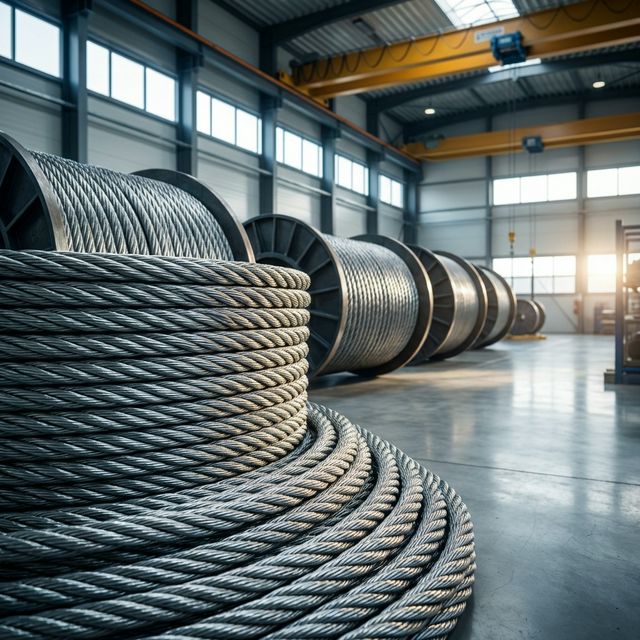
What Is Crane Wire Rope and Why Does Construction Type Matter?
Crane wire rope is the load-bearing element in every Electric Overhead Travelling (EOT) crane, gantry crane, and tower crane application — and its construction type is the single most consequential specification decision an operator or procurement engineer can make. The wrong construction leads to accelerated fatigue cracking, drum crushing, and ultimately catastrophic rope failure under load. Nesh Industries, based in Mehsana, Gujarat, manufactures crane wire rope to IS 2266:2010 in constructions and grades specifically selected for Indian EOT crane duty conditions, including high-cycle lifting, multi-layer drum winding, and outdoor yard crane environments. Selecting the correct construction type determines service life, maintenance cost, and operational safety across the rope's entire working life.
What Is the Difference Between IWRC and FC Wire Rope?
The core — the central element around which the outer strands are wound — defines whether a wire rope is classified as FC (Fiber Core) or IWRC (Independent Wire Rope Core), and this single difference controls four critical performance parameters for crane duty applications.
FC (Fiber Core): The core is constructed from natural sisal fibre or synthetic polypropylene fibre. FC wire rope is more flexible and approximately 3–4% lighter per unit length than an equivalent IWRC rope. The fibre core acts as a lubricant reservoir, releasing oil into the rope during operation. However, under radial crushing loads from a multi-layer drum winding or a sheave, the fibre core compresses permanently — this is called core crush — which reduces the rope's metallic cross-section, lowers its actual breaking force below the rated minimum, and creates internal stress concentrations that accelerate fatigue wire breaks. Per Indian practice and IS 3938 (Electric Overhead Travelling Cranes — Code of Practice), FC construction is not recommended for overhead crane applications where loads exceed approximately 3–5 tonnes, or where multi-layer drum winding is used.
IWRC (Independent Wire Rope Core): The core is a separate, smaller wire rope assembly — typically a 7-wire strand or a 7×7 mini-rope — manufactured and stranded independently before the outer strands are wound around it. IWRC provides three measurable advantages: first, it increases the rope's metallic cross-section by approximately 7.5% compared to an FC rope of the same nominal diameter, directly increasing minimum breaking force; second, it resists radial crushing loads from drum winding and sheave contact without permanent deformation, preserving the outer strands' geometry and load path; third, it maintains rope diameter stability under cyclic loading, which is essential for groove tracking accuracy on multi-layer drums. Nesh Industries IWRC wire rope is manufactured with the inner rope pre-lubricated to IS 2266:2010 lubrication requirements, ensuring the core contributes to internal wire corrosion protection throughout the rope's service life.
Which Wire Rope Construction Is Best for Overhead Cranes?
Nesh Industries recommends the following constructions for EOT crane duty, selected based on IS 2266:2010 classification and IS 3938 crane application requirements:
6×19 IWRC: The 6×19 classification means 6 outer strands, each containing 19 wires. This construction delivers a good balance of flexibility and abrasion resistance. The relatively large outer wire diameter in 6×19 makes it the preferred choice for single-layer drum winding cranes and applications where rope-to-sheave contact abrasion is the primary wear mechanism — for example, outdoor yard cranes working in dusty Gujarat environments. Minimum breaking force for a 16mm 6×19 IWRC rope in EIPS grade per IS 2266:2010 is approximately 176 kN.
6×36 IWRC: With 36 wires per strand (more, smaller wires), the 6×36 construction is significantly more flexible than 6×19 at the same diameter. This is the construction Nesh Industries recommends for multi-layer drum winding EOT cranes, where the rope must bend repeatedly over the drum barrel and into lower rope layers without fatigue cracking at the crossover points. The finer outer wires are more susceptible to abrasion but tolerate bending fatigue better — making 6×36 IWRC the correct default for standard EOT crane duty per IS 3938. Minimum breaking force for 16mm 6×36 IWRC in EIPS grade per IS 2266:2010 is approximately 170 kN.
8-strand constructions: For very large multi-layer drum cranes — typically 20 tonnes and above — 8-strand rope (e.g., 8×36 IWRC) distributes the bending load across more strands, further improving fatigue life on large-diameter drums. The 8-strand rope has a round cross-section that tracks drum grooves consistently, which is critical for spooling accuracy on cranes with long travel distances.
What Wire Rope Grades Are Used in Industrial Cranes?
Wire rope grade refers to the tensile strength of the individual wires, and IS 2266:2010 defines four grades relevant to Indian industrial crane applications. Grade selection directly determines the rope's minimum breaking force at a given diameter — choosing the correct grade allows the smallest possible rope diameter for a given working load limit, which reduces drum size, reduces dead weight on the crane bridge, and improves fleet-angle performance.
IPS (Improved Plow Steel): Minimum wire tensile strength of approximately 1,570 N/mm². IPS is the minimum acceptable grade for any lifting application. It is used for low-duty-cycle cranes and static lifting applications. Nesh Industries does not recommend IPS for overhead crane duty — the low tensile strength requires larger rope diameters for equivalent WLL, increasing drum and sheave dimensions unnecessarily.
EIPS (Extra Improved Plow Steel): Minimum wire tensile strength of approximately 1,770 N/mm². EIPS is the standard grade for EOT crane wire rope across Indian industry and the grade Nesh Industries supplies as the default for crane applications. Compared to IPS at the same 16mm diameter in 6×36 IWRC construction, EIPS delivers approximately 12–15% higher minimum breaking force, allowing a smaller safety margin penalty at equivalent working load. IS 2266:2010 defines EIPS grade wire tensile range as 1,770–1,960 N/mm².
EEIPS (Extra Extra Improved Plow Steel): Minimum wire tensile strength of approximately 1,960 N/mm². EEIPS is used for ultra-high-capacity cranes, offshore lifting, and applications where rope diameter is severely constrained. At 16mm diameter in 6×36 IWRC, an EEIPS rope offers approximately 10% higher breaking force than EIPS. IS 2266:2010 recognizes EEIPS as the highest standard grade.
How Do You Calculate the Right Diameter Wire Rope for Your Crane?
Wire rope diameter selection for a crane involves three interdependent calculations: working load limit with safety factor, sheave-to-rope diameter ratio (D/d ratio), and drum groove geometry compatibility. All three must be satisfied simultaneously — a rope that meets WLL but violates D/d ratio will fail from bending fatigue, not from overload.
Working Load Limit and Safety Factor: The working load limit (WLL) of the rope must be at minimum 5 times the maximum load the rope will lift, per standard crane engineering practice in India. This 5:1 safety factor (also called Design Factor or Factor of Safety) is the baseline for general crane duty; IS 3938 may specify higher factors for specific duty classes. For a 5-tonne EOT crane with a single-part rope reeving, the rope must have a minimum breaking force (MBF) of at least 5 × 5 tonnes × 9.81 m/s² = approximately 245 kN. From IS 2266:2010 breaking force tables for 6×36 IWRC EIPS: a 20mm diameter rope has an MBF of approximately 265 kN — meaning 20mm is the minimum acceptable diameter for this application.
D/d Ratio (Sheave-to-Rope Diameter Ratio): The D/d ratio is the diameter of the sheave (or drum) divided by the nominal diameter of the rope. Every time a wire rope bends around a sheave, the outer wires are stressed in tension while the inner wires are compressed. Too small a sheave forces the rope to bend too sharply, creating cyclic stress reversals that crack wires from the inside outward — invisible until the rope fails. For crane duty, the minimum D/d ratio per good engineering practice is 16:1; Nesh Industries recommends 18:1 as the working standard to achieve the full rated fatigue life of the rope. A 20mm diameter rope therefore requires a sheave with a pitch diameter of at minimum 320mm (16:1), and ideally 360mm (18:1). An undersized sheave on a correctly rated rope will cause fatigue wire breaks within 30–50% of the expected rope service life.
Worked Example — 10-Tonne EOT Crane: For a 10-tonne crane with 2-part reeving, each rope line carries 5 tonnes. Required MBF per rope line = 5 × 5t × 9.81 = 245 kN. From IS 2266:2010 tables for 6×36 IWRC EIPS: a 20mm rope (MBF 265 kN) meets this requirement. Required sheave pitch diameter at 18:1 D/d = 20mm × 18 = 360mm. Nesh Industries supplies this rope configuration and can advise on sheave geometry compatibility — contact +91 99094 95768.
How Often Should Crane Wire Rope Be Inspected and Replaced?
IS 3938 (Electric Overhead Travelling Cranes — Code of Practice) mandates a structured inspection regime for crane wire rope. The following schedule applies to EOT cranes operating under standard duty conditions in Indian manufacturing and infrastructure environments.
Daily Visual Inspection (every operating shift): The crane operator must visually examine the full accessible length of the rope for visible broken wires, kinks, flattening, or bird-caging. Any of these conditions found during a daily check is grounds for immediate removal from service before the next lift. Check also for lubricant condition — a dry rope surface indicates the internal lubricant has depleted and re-lubrication is required.
Periodic Detailed Inspection: A trained maintenance engineer must inspect the full rope length at intervals not exceeding one month under normal duty conditions — more frequently for cranes in Class M5 and above per IS 3938 duty classification. The inspector must examine: the number of broken wires in any one lay length (the length corresponding to one complete strand helix); the condition of rope end terminations including spelter sockets, swage sockets, and thimble-and-clip assemblies; and the rope diameter at the midpoint relative to its nominal diameter (reduction exceeding 6–7% indicates significant internal wear).
Discard Criteria per IS 3938: A crane wire rope must be taken out of service immediately when any of the following conditions are present: (1) The number of randomly distributed broken wires in one rope lay length exceeds 5% of the total wire count — for a 6×36 rope with 222 total wires, this means 11 broken wires per lay length; (2) The number of broken wires in one strand in one lay length exceeds 2 broken wires; (3) A valley break is found — a wire broken at the contact point between strands; (4) Kinking, birdcaging (strand protrusion forming a cage), or core protrusion is visible; (5) Severe corrosion with surface pitting on individual wires; (6) Heat damage evidenced by discolouration, melting of wire surfaces, or loss of wire temper. These are mandatory IS 3938 discard criteria — not guidelines. A rope showing any single one of these conditions is an immediate out-of-service item.
Typical Replacement Interval: Under normal single-shift EOT crane duty at Class M3–M4 per IS 3938, with correct lubrication and IS 2266-compliant IWRC rope from Nesh Industries, a 6×36 IWRC EIPS rope on a correctly designed sheave system will typically achieve 12 to 24 months of service life before reaching discard criteria. Cranes operating two-shift or three-shift schedules, or Class M5–M6 heavy duty, should plan for rope replacement every 6–12 months regardless of wire break count.
Frequently Asked Questions About Crane Wire Rope
Does Nesh Industries supply IS 2266-compliant IWRC wire rope for EOT cranes?
Yes. Nesh Industries, Mehsana, Gujarat (GSTIN: 24AUQPP5888B2Z4) manufactures and supplies 6×19 IWRC and 6×36 IWRC wire rope in IPS, EIPS, and EEIPS grades, fully compliant with IS 2266:2010. All ropes are supplied with a material test certificate confirming breaking force, wire tensile strength, and construction. Nesh Industries serves EOT crane manufacturers, crane hire operators, and maintenance contractors across Gujarat, Rajasthan, Maharashtra, and all major Indian industrial centres. Contact the technical sales team at +91 99094 95768 for construction recommendations, diameter selection assistance, and quotation.
What is the difference between galvanized and ungalvanized wire rope for crane applications?
Ungalvanized (bright) wire rope has a slightly higher minimum breaking force at the same diameter and grade compared to galvanized rope — the galvanizing process marginally reduces wire tensile strength by approximately 5–8%. For indoor EOT cranes in dry factory environments, bright (ungalvanized) IWRC rope is the standard and preferred choice, as it maximises breaking force for a given diameter. Galvanized wire rope per IS 2266:2010 is specified for outdoor cranes, port and yard cranes, marine applications, or any environment where the rope is exposed to rain, humidity, or corrosive process atmospheres. The zinc coating provides a sacrificial barrier that prevents corrosion from penetrating to the inner wires and core, extending rope life significantly in corrosive conditions — at a modest breaking-force penalty. Nesh Industries supplies both bright and hot-dip galvanized IWRC wire rope to IS 2266 specifications.
Can I use 6×19 FC rope on a multi-layer drum crane?
No. 6×19 FC rope is not suitable for multi-layer drum winding. The fibre core crushes permanently under the pressure of upper rope layers bearing down on lower layers during winding, reducing the rope's effective diameter and causing the strands to distort out of their designed helical geometry. This distortion creates stress concentrations that initiate fatigue wire breaks at a fraction of the rope's rated fatigue life. IS 3938 effectively prohibits FC construction for EOT cranes above low-capacity, single-layer drum applications. For multi-layer drums, Nesh Industries recommends 6×36 IWRC EIPS as the minimum specification — the IWRC core resists crushing and the 6×36 construction provides the flexibility needed to accommodate multi-layer crossover points without fatigue cracking.
What diameter wire rope is recommended for a 10-tonne EOT crane?
For a standard 10-tonne EOT crane with 2-part rope reeving (each rope line carrying 5 tonnes of load), Nesh Industries recommends 20mm diameter 6×36 IWRC EIPS wire rope per IS 2266:2010. This diameter provides a minimum breaking force of approximately 265 kN, achieving the required 5:1 safety factor (5 × 5t × 9.81 = 245 kN required). The sheave and drum groove diameter should be a minimum of 320mm (16:1 D/d ratio) and ideally 360mm (18:1 D/d ratio) to achieve full fatigue life. For cranes with single-part reeving carrying the full 10-tonne load, a 28mm or 32mm rope may be required depending on exact reeving geometry and crane duty class per IS 3938.
How do I order crane wire rope from Nesh Industries?
To order IS 2266-compliant crane wire rope from Nesh Industries, contact the technical sales team at +91 99094 95768. Provide the following information for an accurate quotation: crane capacity (tonnes), reeving factor (number of rope parts), duty class per IS 3938 (M3, M4, M5, etc.), drum and sheave diameter, required rope length, environment (indoor/outdoor/corrosive), and preferred delivery location. Nesh Industries supplies wire rope on reels with GSTIN-invoiced delivery across India (GSTIN: 24AUQPP5888B2Z4, Mehsana, Gujarat). Standard in-stock diameters range from 10mm to 40mm; non-standard sizes are available on enquiry with a 2–3 week manufacturing lead time.